Showing posts with label James Bond. Show all posts

Sunday, July 7, 2013

I Took My Time Machine to the Mechanic, Part One

     In 2008, I got my first "big boy" job out of college.  I was making the most money I'd ever made in my life, so I decided it was time to buy the watch I'd been lusting after for the past eight years: the Omega Seamaster Professional chronometer, model 2531.80, aka "The James Bond Watch."  I did my research to make sure I got an authentic specimen on eBay, and I've been enjoying it ever since.

Omega Seamaster Professional, model 2531.80.  Cue the James Bond theme music.

     Flash forward to 2009.  I'm still at my big boy job, trapped in a mind-numbing tax code training class. My fellow inmate, Paul, notices the Bond watch on my wrist.  He says that he, too, owns an Omega and that he'll wear it the following Monday.  Monday comes and we both try on each other's watch.  His is an older model Seamaster, a cross between a De Ville and a Seamaster.  The white face and two-tone gold-and-stainless-steel construction make it dressy, but the metal Seamaster bracelet and the wave pattern on the dial keep it somewhat sporty.  I instantly start wondering if Paul would consider selling his timepiece of the last 10 years.  However, given my lack of cash at the time, I do not give voice to my curiosity.
     To my pleasant surprise, Paul approaches me a few weeks later, giving me first dibs on purchasing his watch.  I make a cash offer he rejects as too low.  He proceeds to list the Seamaster on eBay and I resign myself to buying that model Seamaster a few years later.  Flying out to visit my buddy Jacob in California takes my mind off the near-miss.
     The day after I returned from California, I received a voicemail from Paul.  In a fit of sentimentality, he decided to return the money to the winning eBay bidder and hold on to the watch that he loved.  However, he ended up contacting me because he was hard-up for money and absolutely needed to sell the watch.
     I met Paul and his young daughter over lunch the next day.  Paul honored my original offer (which was less than what he would've received from his eBay buyer) and I went home with a time-telling trophy.

Omega Seamaster, model 2301.21.
I still thought it was beautiful, scratches and all.


     I enjoyed my second Seamaster for several months and one night...it all ended.  I heard something pop when I was winding the watch and from that point forward, the watch wouldn't wind or keep time at all.
     Thinking it would cost more to fix the watch then the amount I spent on it, I never looked into getting it fixed.  I would pretend it worked when I wore it...to sleep.  
     Earlier this year, my mom convinced me to take it into the Russell Korman jewelry store for a free repair quote, just to see if it would cost as much as I thought it would.  And that is where Part Two of this tale picks up.  Look for it soon...

Thursday, February 21, 2013

My First Road Test: 2005 Ford Thunderbird


      The Ford Thuderbird was first introduced in model year 1955 and was in production, off and on, for the next 50 years.  Over the years, it became an American automotive icon.  Arthur Miller and Marilyn Monroe were snapped by the paparazzi in a black T-Bird with the top down.  A 1961 "Bullet Bird" had the honor of being a part of JFK's inaugural parade.  Ol' Blue Eyes himself, Frank Sinatra, had a Thunderbird. 
     Unfortunately, that Hollywood luster faded by 1997, when the Thunderbird was discontinued.  Ford couldn't leave one of its most famous models alone for long, though.  By 1999, it had a Thunderbird concept vehicle ready for the North American International Auto Show.  The production version of the brand new Thunderbird was unveiled in 2001.  This time, it didn't need celebrity owners.  It was a star in its own right (and in the 2002 James Bond movie, "Die Another Day") and shone all the brighter when it was named Motor Trend magazine's "Car of the Year."
     I must admit that, as big of a 007 fan as I am, the coral T-Bird in "Die Another Day" didn't really stick out to me.  It wasn't until a year or two ago that I even gave the car a second thought.  I love products made my American companies with long-standing pedigrees and illustrious histories, like Brooks Brothers clothing, Johnston and Murphy shoes and Tiffany & Co. silver accessories.  It seems inevitable that I would be drawn to the Ford Thunderbird.  I fell in love with its looks and its nostalgia factor, but I knew I had to test drive one to see if reality would match my romantic vision of it.


Driving Notes
  • Looks.  The 11th-generation Thunderbird is a great modern interpretation of a classic design.  The egg crate front grille is present, as are the afterburner taillights.  Ford brought elements of classic T-Birds into the 21st century without excessively aping ancestral designs, like the new Dodge Challengers.  The body tapers dramatically front to rear, giving the car the appearance of squatting down on its rear springs as it accelerates off the line.  A lot of these T-Birds have chrome wheels with 5 thick spokes, but, unfortunately, this 50th Anniversary edition comes shod with 16-spoke alloys that look too small under the amount of car that rides atop them.  I love the large, flat trunk lid because it reminds me of old-school American cars with trunks big enough to make into mobile apartments.  However, when you open this one, it looks more like a broom closet inside.  This car is definitely a weekend machine.        
  • Interior.  I knew going into this test drive that the interior would make or break my love affair with this car.  I was already sold on its exterior.  Upon getting inside the snug, primarily black interior, my girlfriend loudly said, "It's like a cave!"  I was instantly put off, as well.  I consider myself statistically average height (5'10" with shoes on).  My hair was brushing the inside of the lined convertible top - an issue I've never had with another car, even the tiny Honda S2000.  The windshield was so short and steeply raked that forward visibility was impractically limited.  When the sun visors were flipped down, I could barely see the road in front of me.  When they were flipped up, they were right in line to chop the top of my head off under heavy breaking.  The insert in the driver's door panel and the panel surrounding the cigarette lighter was loose (see picture), bringing the mystique of this car down a few pegs.  However, I kind of expected fit and finish problems in an 8-year-old American car's interior.   
  • Exhaust note.  I was pleasantly surprised when I turned the key.  I knew there was a V8 up front, but I figured, given its small size (3.9 liters) and the car's boulevard cruiser persona, that it wouldn't have the satisfying, throaty, low growl I heard.  It instantly brought a smile to my face.  Hearing the sound trail behind me as I drove around the block with the top down on a balmy, sunlit day was a simple pleasure that I believe many Americans have felt behind the wheel of a Thunderbird over the past 50+ years.
  • Cowl shake.   I'd read about "cowl shake" (chassis flex and vibration present in convertible cars, which lack the structural rigidity of fixed-roof cars) in car magazines before, but I'd never experienced it.  This car definitely had it.  In my 5-minute drive through the neighborhood streets around Covert Ford, never exceeding 40 mph, I could feel the area around the firewall and the front end shimmy and shake when going over road imperfections.

VITAL STATS
Engine: 3.9L V8
Power: 280 HP / 286 LB-FT
Transmission: 5-Speed Auto
Drivetrain: Rear-Wheel Drive
Curb Weight: 3,781 LBS
Seating: 2
MPG: 18 City / 24 HWY
(Figures courtesy of ThunderbirdConcepts.com.)


Those chrome rocker panels allow you to see your saddle shoes before you get in and take your sweetie to the drive-in in this automotive blast from the past.

I love the afterburner tailights and the subtle, chrome-tipped dual exhausts.


Possibly the best view of the Thunderbird: big round headlight eyes and chromed egg crate grille smile.


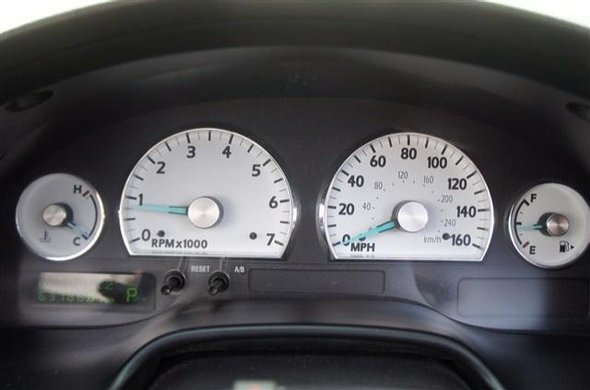
The turquoise needles added an attractive splash of color to otherwise plain black-on-white gauges.
On the bottom right, you can see where the fascia panel had come loose.

The 5-speed automatic transmission delivered snappy, confident shifts.

While the metal-finish trim on the driver's door was attractive and relieved the dourness of an all-black cabin, it was also loose to the touch.

The brightwork touches lead your eye around the shrinkwrap interior.

Looks like a tight fit in there.  I like how Ford chose to use a tastefully sized engine cover that didn't obscure absolutely everything under the hood.
The little embroidered mat was a nice touch.  It didn't distract me from the trunk's lack of depth, though.

     A few shout-outs: Mitch Larkin at Covert Ford was a very friendly and accommodating salesman that let me fly this 'bird with him.  Go see him and find out if you fit into this car better than I did.  It's still for sale, here: http://covertford.com/Austin-TX/For-Sale/Used/Ford/Thunderbird/2005-50th-Anniversary--Car/15721164/.  All of the above photos are courtesy of CovertFord.com.

     Thanks to Media.Ford.com for some of the information used in this review.

     Finally, I must thank Autoblog.com and its Quick Spins for the design inspiration for this post.

Sunday, January 13, 2013

John Z. DeLorean and the Media

          Below is the term paper I wrote for my Critical Issues in Journalism class, in which I discuss the media biases applied to and exploited by John Z. DeLorean.  I got a perfect score on it.  (Yay!)  Please let me know what you think of it. 


John Z. DeLorean and the Media

          As a captain of industry, the late John DeLorean was not a stranger to the media and the biases with which it operated.  As an ideas man and skilled promoter, he also used those media biases and prevalent practices to his advantage.  DeLorean was a target for cueing, an exploiter of framing and possessed the credibility to support that framing.
          It should come as no surprise that DeLorean, a successful engineer with Packard and lucrative division manager at General Motors, was the subject of rampant media cueing.  One cue applied to DeLorean was the sort, using a variety of words, which painted a picture of him as a flashy, jet-setting, glamorous playboy.  DeLorean’s obituary from the New York Times in 2005 included a description of him as a “flamboyant automobile industrialist” in its first line.  Houston station KHOU-11’s coverage of the revived DeLorean Motor Company several years ago called the DeLorean DMC-12 “a sports car built by the rich and famous for the rich and famous” and DeLorean himself “a jet-setting ex-GM celebrity.”  Hemmings Muscle Machines magazine described his lifestyle as “extravagant” and “rockstar-like.”  The documentary “Anything to Win: The Crash of John DeLorean” called him “an international playboy” and “an iconoclastic celebrity businessman.”
          Another type of cue used for DeLorean was that which depicted DeLorean as a rebel or nonconformist.  As far back as 1969, Sports Illustrated said, “Yet there are those who predict that General Motors will clamp down on its house rebel and that he will accept the clamps if he harbors any thoughts of gaining the corporation's presidency—a job at least 10 years in the future if GM tradition means anything.”  People magazine published the 1980 article “G.M. Renegade John Delorean Toots His Own Horn with a New Life, New Book and a New Car.”  In 2008, The Detroit News ran an article titled “The rise and fall of John DeLorean, dashing, maverick automaker.”
          The third cue the media has used for DeLorean is that of conman, although he was never convicted in his notorious cocaine trafficking case.  The New York Times Style Magazine described him as a clarinet-playing former engineer that turned into a hipster conman.  In 2005, The Guardian summarized DeLorean as “a world-class conman” for his association with fraud, embezzlement, tax evasion and defaulted loans in its article “John DeLorean: American car-maker and conman whose victims included the UK and the US governments.”
          It is clear that DeLorean was a bountiful source of cueing opportunities for the press and that the press indulged in those opportunities often.  Cues such as “jet-setting”, “maverick” and “con man” are quick, easy ways of not only gaining an audience’s attention, but of emotionally involving the audience in the story.
          Given DeLorean’s well-known history of legal troubles, it seems appropriate that his story is one rife with framing - albeit media framing, constructed by those at DeLorean Motor Company and the media itself.  The DeLorean DMC-12 print ad and commercial featured the tagline “Live the Dream.”  This frame tapped into consumers’ inner Walter Mitty complexes.  Automobiles inspire visions of freedom, independence and unforgettable journeys and the gullwing doors swinging up as the line is superimposed on the screen and gulls flying over the ocean only serve to entice viewers to chase those visions and live their dreams behind the wheel of the DeLorean DMC-12.  Automobiles are also glamorous status symbols and the DMC-12 print ad showed DMC’s awareness of this by stating that other drivers would be envious as a DMC-12 owner drove by.
          Another example of framing lies in the media stating that DeLorean “broke the mold” in the automotive industry.  Forbes magazine said DeLorean “broke the mold” when he founded his eponymous motor company in 1975.  Fox News’ obituary for DeLorean said, “DeLorean ‘broke the mold’ of staid Midwestern auto executives by pushing General Motors Corp. to offer smaller models, auto historians said.”  Such a frame is comprehensible and familiar to most news viewers and implies that DeLorean is exciting and revolutionary, which is, conveniently, the kind of person viewers are likely to tune in to see and learn more about.
          DeLorean had the credibility to justify his self-imposed framing.  One could argue that he lived the dream suggested by his company’s advertising.  He dated glamorous movie stars Raquel Welch and Ursula Andress while he was a free-wheeling bachelor.  DeLorean was married to Kelly Harmon and the successful model Christina Ferrare, undoubtedly the objects of many a man’s desires.  He also had lavish estates in New Jersey and New York and socialized with celebrities such as Johnny Carson and Sammy Davis, Jr.  Luxurious homes and high-profile friends are typically envied possessions - much like a DMC-12 would appear to other motorists.  Perhaps this credibility is what caused the DMC-12 to be such a highly anticipated release and DeLorean to be such a successful automobile promoter.
          Although the media filtered the picture of John DeLorean through its prism of cueing, he was able to appeal to customers by making them see the DMC-12 in the favorable light cast by advantageous framing and shined brightly as a beacon of credibility.